
AyudantIA: UC Chile’s Innovative Project Bringing AI into the Classroom
The project provides students with on-demand support through virtual tutors—chatbots personalized for each course by the professors themselves. This is AyudantIA, Universidad Católica’s groundbreaking initiative, currently in its implementation phase. With over 170 AI agents developed, 2,300 active users, and more than 10,000 conversations to date, the project is already making an impact.
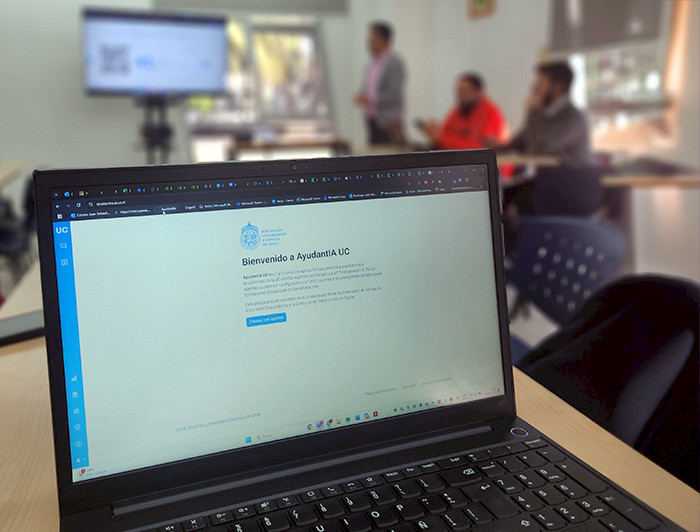
photo_camera The AI agents act as virtual tutors, available 24/7 to answer questions, reinforce lessons, and provide personalized guidance. (Photo credit: Office of the Vice President for Digital Intelligence)
AyudantIA is an institutional project that trains faculty members across various departments to create their own AI agents. These chatbots are built using course-specific materials, bibliographies, and content, designed to guide students through the learning process.
These AI agents act as virtual tutors, available round the clock to answer questions, reinforce concepts, and offer personalized support, all within a secure and ethical framework validated by course instructors.
So far, the project has achieved remarkable engagement within the university community. A total of 92 professors from 26 general education courses and 68 courses across various disciplines are involved, giving over 10,000 students access to these AI-powered tutors.
Benefits for Students and Professors
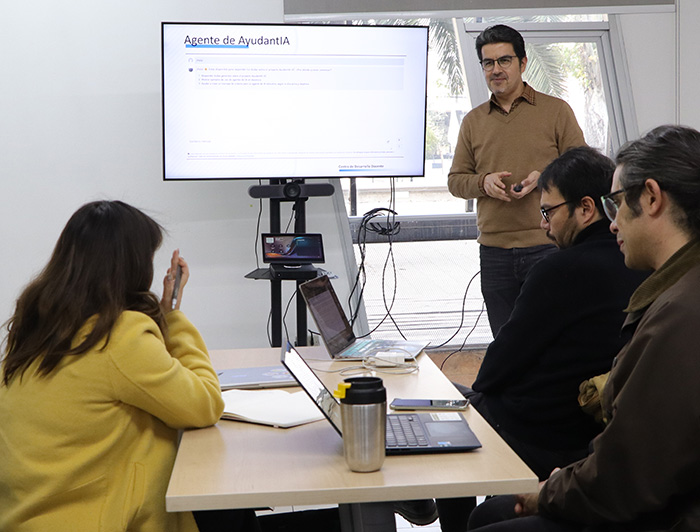
For students, AyudantIA offers personalized tutoring 24/7, allowing them to resolve doubts and reinforce their learning in real time. For faculty, it has become a valuable space for pedagogical experimentation, providing a platform to design supportive, ethical, and course-aligned learning environments.
In the Microbial Biology course, Professor Carolina Serrano from the Faculty of Biological Sciences took an innovative approach by integrating AI into the teaching and learning process. Her challenge was significant—her class included students from a wide range of backgrounds, from Biological Sciences to Engineering and College courses.
To address this diversity, she organized interdisciplinary seminars where students worked in small groups to solve case studies, present their findings, and discuss them through problem-based learning sessions. The innovation: for the first time, students could use AI to generate graphics, images, and visual resources, provided they properly cited sources and tools.
“At first, there was some hesitation, but the students quickly adapted. What used to be text-heavy slides are now clear, well-referenced visuals. Students realized that AI doesn’t replace their effort—it helps them communicate ideas more effectively,” explains Serrano.
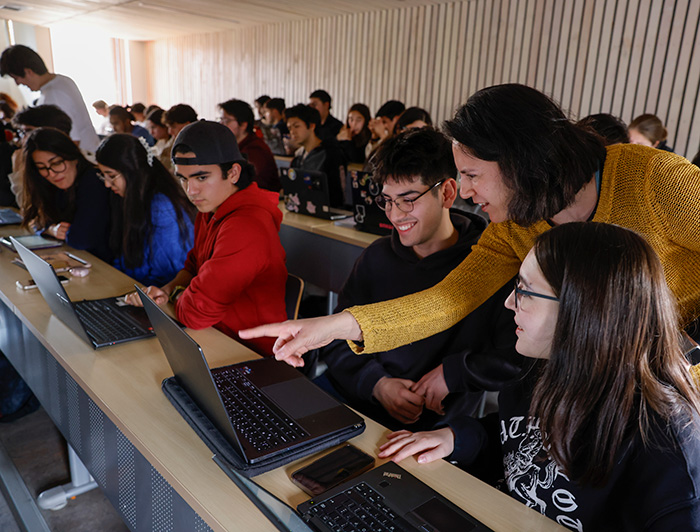
The results speak for themselves: seminar grades averaged above a 6 (on Chile’s 1–7 scale), and, importantly, disparities between degree programs decreased. “AI democratized learning. Everyone now has the same opportunity to access knowledge,” Serrano adds.
The experience not only impacted academic results but also encouraged responsible AI usage. Serrano emphasizes that clear rules are essential for effective classroom use: students must work within the class environment, cite sources, explain the resources they use, and demonstrate mastery of the content. “AI is a powerful tool when used wisely and within a clear pedagogical framework. For students, it means a tutor available 24/7; for professors, it’s an opportunity to innovate in teaching.”
With AyudantIA, Serrano’s course not only adapted to the digital age but also improved learning outcomes and promoted equity. I believe the higher grades are a result of good AI usage. Students have told me it’s helped them tremendously, and they’re encouraging other professors to try it,” she concludes.
A Strategic Project for UC Chile
AyudantIA is a key part of UC Chile’s institutional strategy to position the university as a regional leader in the responsible use of AI in higher education. Partnerships with the University of Sydney and Microsoft strengthen this leadership and open up new avenues for academic innovation.
Vice President for Academic Affairs Mario Ponce highlights that the AI agent’s implementation “represents a decisive step in our commitment to innovate in university teaching. This project does not aim to replace faculty members, but rather to enhance their work: we want professors to have new tools to enrich their classes, and students to have better and more accessible learning opportunities. Initiatives like this move UC Chile closer to leading the responsible use of AI in higher education in the region.”
Vice President for Digital Intelligence Paula Aguirre adds, “AyudantIA is a pioneering initiative that supports learning and teaching at UC Chile through responsible AI. Our goal is to harness these technologies for the benefit of education, strengthening faculty roles and expanding learning opportunities for students. This pilot program is part of a broader set of strategic projects led by the Office of the Vice President for Digital Intelligence, designed to enrich campus life and position UC Chile as a leader in educational innovation and digital intelligence.”
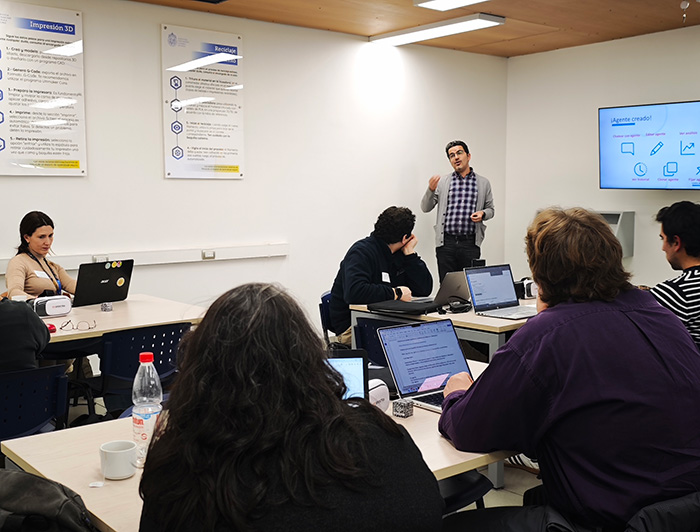
Students also value the initiative, particularly as technology rapidly transforms multiple fields. Luis Soto, an Engineering student and Assistant Counselor, remarks: “It’s crucial to implement these technologies. They’re new and innovative, and as students, we have a voice in shaping how they influence our education. This directly impacts our learning and future job prospects, where these tools will be fully developed. We need to start understanding their potential now.”
In the second semester of 2025, the project will continue to evaluate results and gather feedback from students and faculty, with the goal of expanding to additional academic units. The aim is to fully integrate AyudantIA into UC Chile’s 2026–2030 strategy, strengthening a digitally connected university while maintaining its ethical standards and focus on developing well-rounded professionals.
The results reflect a highly participatory process:
- 2,316 total users
- 171 agents created, 137 during the pilot phase
- 59 agents built with GPT-4o, 112 with GPT-4o-mini
- 92 participating professors
- 26 general education courses, 68 disciplinary courses
- 26 general education courses, 68 disciplinary courses
- Ayudín para Ayudantes, CDDoc – 1,100+ unique users
- Escorterr.IA School of Engineering – 900+ conversations and Tutor socrático Faculty of Social Sciences – 550+ conversations
- Innovative experiments like ChomskIA (Faculty of Letters), PasteurTest (Faculty of Agronomy and Natural Systems), and KineBioBOT (Faculty of Chemistry and Pharmacy) demonstrate the project’s broad interdisciplinary reach.


